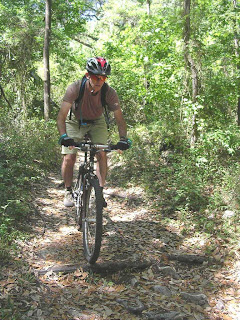
There is a common belief out there that the people you see effortlessly and fearlessly cruising along amidst all those automobiles have exceptional skills that most people don’t have. Not true. That’s not to say they don’t have skills, and they may indeed be skills that you lack as a novice cyclist. These are not exceptional skills, but they are necessary. Assuming you have a bike that fits and is in good mechanical order, let’s explore those skills. (I plan to have video demonstrations on these in the future.)
Mounting the Bike
With one hand on the handlebar and one on the saddle, pull the bike down towards you so that you can pick up your leg and step over the top tube. If you’re more flexible and comfortable with it you can hold the bar with both hands and swing your leg over the saddle and back wheel while your other foot is on the ground.
Power Pedal
There is a right way and wrong way to start a bicycle from a stop. You’ve probably seen folks with a foot on one pedal and the other foot paddling along on the pavement trying to get the bike rolling. It looks rather sad, doesn’t it? It’s also a bit dangerous. If you’re attempting to cross a wide street, you may not be able to get up enough speed to keep from colliding with cross-traffic.
The Power Pedal technique is simple. Pull one pedal (whichever feels more natural for you) up so that it’s about two-thirds from the top of the pedal rotation. Put your foot on that pedal and stand on it. This will naturally push you up and onto the saddle, and your other foot can easily find its pedal. Now you’re fully in control of the bike and can accelerate and shift as needed.
Shoulder Check
This is an absolutely critical skill, and some adults haven’t learned it! It doesn’t matter if you’re on a quiet residential street, a busy urban roadway, or even on a sidewalk; the ability to scan over your shoulder without making the bike swerve is a necessity. The mistake an inexperienced cyclist will make is pulling the left end of the handlebar with the left hand as he turns his head. This of course makes the bike swerve left before the cyclist has checked to be sure it’s safe to move left!
Practice this skill in an empty parking lot. You can use the parking space lines to keep track of how straight you ride. Your arms should be slightly bent at the elbows. This is a very good practice in general; it reduces stress on your hands, wrists, and shoulders, and keeps you from wobbling or oversteering. Drop your shoulders a bit and focus on just turning your neck and head. If your have mobility issues with your neck, or you want to get an especially good view of what’s going on behind you, take your left hand off the bar and place it on your thigh. Remember, it’s your left hand which inadvertently pulls on the bar; the right doesn’t push it.
Practice these variations until you can do them with minimal swerving.
About Mirrors
Many cyclists like to use a rear-view mirror, myself included, but a mirror cannot take the place of a full shoulder check scan. Turning your head is a signal to the following motorist that you are planning to do something. When changing lanes or turning left it’s very helpful to gain eye-contact with the following driver. While you may see the driver behind you; he only sees you signaling and moving across his path, perhaps making him think you’re not being cautious.
Scanning Ahead
While bicyclists are often concerned about motor vehicles approaching from behind, it’s really the ones coming from the front and sides that pose the most danger to you. A good rule of thumb is to scan for where you will be in about ten to twelve seconds. You’re looking for pavement problems, motorists coming out of driveways, pedestrians who might be about to cross, parked cars…all the sorts of things you scan for as a motorist. Scanning as a cyclist is a skill that’s based on knowing what to look for.
Braking
In another post I will cover emergency braking techniques, but such techniques are rarely needed for most situations. Still, you should understand how to use your brakes. Many novices are afraid of the front brake, believing it will “throw them over the handlebars.” Such fears are probably based on childhood mishaps or on poorly maintained bikes. A well-maintained front wheel and brake will stop you safely and effectively. This is important because your front brake has about 70 percent of your bike’s braking power.
Get in the habit of pulling the brake levers progressively; don’t yank them in all at once. As with the shoulder check, find an empty parking lot or quiet street on which to practice. Use both the front and rear brakes together. In the US, the front is controlled by the left lever and the rear the right. If you should happen to start pitching over the bars, don’t panic. Your first clue that this is happening is the skidding of your rear tire; but this will only happen if you’re using both brakes. If the rear tire skids, merely ease up on the front brake and you will not pitch over.