Showing posts with label Bicycle Selection. Show all posts

Sunday, November 25, 2007

What's That Funny-Lookin' Bike On Your Banner?

It goes by various names; a longtail or a Sport Utility Bicycle (SUB). More specifically it's a Marin Novato with an Xtracycle Freeradical conversion kit. And even more specifically, mine is named Lakshmi, after the Hindu goddess of good fortune.

The Xtracycle combination means you'll rarely have the excuse of saying, "But I can't carry..."

Here's an example of a typical load: 80" bi-fold door and other miscellaneous stuff from Lowes, plus four bags of groceries from the produce stand and the supermarket; all in one 10-mile round trip.

For more examples of what people carry on SUBs, go here.

Thursday, November 1, 2007

What Type of Bicycle?

Your choices for buying a quality bicycle are far better today than a decade ago, and light-years better than 20 years ago. Twenty years back you could either buy a road bike or a mountain bike. That was about it. Today there are so many variations it would be hard to list and describe them all.


I'll start with the road bike. This is what people used to call a "ten-speed," but you'll really be dating yourself and showing how out of touch you are by using that term, so stick with "road bike." The purpose of a road bike is to go fast. Period. It's light, the handlebar position puts you in a more aerodynamic position, and the tires are narrow to reduce rolling resistance. This is the bike for fast weekend rides with the local bike club. NOT the comfortable cruiser for around the neighborhood with the kids. Road bikes will come with anywhere from 18 to 30 gears, depending on the model and sub-category.


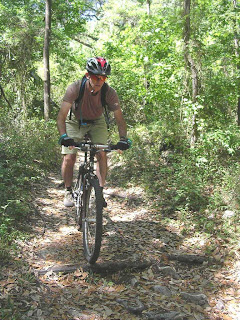
For a while the mountain bike was the bike people bought if they couldn't stand the uncomfortable position of the road bike; but then, those were the only two options. While mountain bikes are okay for around town riding (especially if you have heavily potholed or bumpy brick streets), they are really built for rugged unpaved trails through the mountains and woodlands. If you are interested in riding those rugged trails, but also want to have just one bike that will also take you around town, the mountain bike will do well. They come as either "full" suspension (front and rear; shown above), "hardtail" (front suspension only), or "rigid" (no suspension). A "hardtail" with smooth tires for the street can be a very good around town bike, especially with a rear carrier rack. Changing from smooth street tires to knobby trail tires can be a hassle; some riders have a second wheel set built for the second set of tires; changing wheels is easier than changing tires, and a second set of wheels can be cheaper than a second bike (and take up less room). Full suspension bikes are generally not so good for around-town use, because you can't mount a good rear carrier rack (unless you want spend over $100 for one made for rear suspension.)


A broad range of bikes called "comfort" or "hybrid" or "urban" bikes combine elements of road bikes and mountain bikes, and often do so with a more upright seating position. The tires will be midway between road and mountain; wide enough to handle a little dirt and absorb some road shock, narrow enough to give reduced rolling resistance. Some are now being built with 7- and 8-speed internally-geared hubs instead of the derailluer and cog system found on most bikes. These internally-geared hubs are very user-friendly, enabling you to shift while stopped, and freeing the rider from worrying about a chain that might derail from the cogs or chainrings.


"City" or "commuter" bikes are finally catching on with US bike companies. Similar to the "urban" bikes above, they go a step further and provide accessories that help make cycling a practical mode of transportation: rear carrier rack, fenders, kickstand, and sometimes a chainguard and front and rear lights.


If just want to keep it really simple, there's nothing wrong with a good ol' cruiser. Most are single-speed with coaster brakes, but some have internally-geared hubs and handbrakes. If style is your primary concern, there are tons of options available today.


Lastly (though there are still plenty more types of bikes I could be covering here -- I'll get to them all eventually!), there is the recumbent. If comfort is your primary concern and you don't have plans to ride those rugged mountain trails, this is the bike for you. You sit in a real seat, and pain to your hands, arms, neck, back, butt and (ahem) soft tissues are concerns of the past. As with so many general bicycle types, they also come in a variety of sub-categories: long-, mid- or short-wheelbase; under or above the seat steering; varying seat angles and heights; even three wheel versions.

In a future post I will cover some of these options in greater detail; especially urban and commuter bikes. Then there's always fixies, tandems, touring, cyclocross, choppers, crank-forward bikes, folders, travel bikes, long-tails, cargo bikes......better get a bigger garage!


Monday, October 29, 2007

How to Buy a Bicycle: Part Deux: Buying Used

If you're not ready to plunk down $250 or more for a bicycle, you may be able to get something decent used, but if you're also that novice with little or not knowledge about bikes, you're going to need that experienced cyclist friend or family member. He or she can help ensure the bike is the right size and of decent quality and condition.

People selling lower- and middle-range bikes are often unclear about what they have and what size it is. It's very common to see an ad for a "26-inch men's mountain bike" for instance. 99.99% of the time that means a bike with 26-inch wheels, not a 26-inch frame. Frame size is what determines whether the bike will fit or not. (My wife is 5 feet tall and I'm 5'8"; we both ride mountain bikes with 26-inch wheels. Hers is a 13-inch frame and mine is a 16-inch. A 26-inch frame is for professional basketball players.)

The seller may be able to give you some idea of the bike's fit potential; ask how tall the rider is. Your experienced friend can help if you get a photo via the web or e-mail. That can help you screen out the bikes that definitely won't fit.

When you think you have a bike you'd like to see in person, you'll need your friend again. He or she can look it over for mechanical issues you might not catch. The frame and the wheels are the parts you'll want to inspect the closest; other parts are less critical and cheaper to replace. Look for cracks, rust (on steel frames), and ripples in the paint. Those ripples mean the frame was seriously stressed in a crash; walk away from that one. Make sure wheels are reasonably true and the bearings aren't crunchy.

Make sure the bike fits by straddling the top tube and lifting the handlebars straight up. For a road bike with a top tube parallel to the ground you should be able to lift the front wheel one to two inches off the ground. If it's a mountain bike, a hybrid or comfort bike, or a road bike with a sloping top tube, you should be able to lift the front wheel two to four inches. Have your friend set the saddle to the correct height so you can go for a ride together; he or she should be able to see any obvious fit or mechanical problems that way.

Sunday, October 28, 2007

How to Buy a Bicycle

I'll make it quick and simple for you: go to a bike shop.


OK, it's not that simple, but going to a bike shop will ensure you're heading in the right direction.

Those big-box retailers and sports equipment stores are terrible places to buy bicycles because...
  • Their bikes tend to be of poor quality
  • Their staff tend to know little or nothing about cycling
  • They don't and can't provide service for mechanical issues (and there will be mechanical issues)
  • They have limited selections for both sizes and types of bicycles
Buying a bike for $89.95 at MalWart is like buying a pair of $3.99 flip-flops for walking around town to work and the grocery store. Worse yet, those "flip-flops" only come in size 6, while you wear size 10. In a couple of months when, like Jimmy Buffett, you "blow out your flip-flop" and take the bike back to MalWart, they can only give you (if you're "lucky") another $3.99 pair of size 6s.

Some people complain that bicycle shops are snobby. Some are. If you have a friend who bikes, ask him or her which shops are likely to be friendlier to new riders. If you don't have such a friend, be prepared just in case you get that snotty salesperson who insists you need a $2,500 racing bike, or laughs when you tell him you just want to ride around the neighborhood or to the grocery store. Ask him (and it will usually be a "him" if this happens) if he could suggest another shop that might be interested in your business. He may actually do that! Some shops really do cater mostly to experienced enthusiasts, and will be more or less happy to make such a suggestion.

Before you walk in the door, figure out what you might want to do with the bike. Will it be primarily for transportation? For fitness? For unpaved trails in the woods? For riding across the country carrying your own camping gear? It may be one or all of those, but don't expect that one bike can do everything you might want to do; that's why many cyclists have more than one bike. A good bike shop salesperson will ask you right up front what you want to do with the bike.

I always recommend that people ride a wide range of prices, from the $250 entry level to the $1,200 high-quality. That way you get a better understanding of what more money gets you with a bike.

(Above that thousand-dollar range you probably won't notice any difference between bikes except for (maybe) weight. Kind-of like the way I couldn't tell you the difference between a $20 bottle of wine and a $200 bottle.)

When budgeting for a bike, remember you're going to need quite a few necessities that aren't included, such as a helmet, a water bottle and cage, a pump (a floor pump for home and/or a frame pump that goes on the bike), a good lock, and a small tool kit. Definitely get a floor pump so you don't have to rely on putting your bike in the back of the car to take it to the gas station where you'll pay 25 cents to use a pump likely to over-inflate and burst your tube. That'll keep you off the bike better than anything.

Are you planning to use your bike for trips to the store or to work? Then you'll need a rear carrier rack (like this) and panniers (like these). Front and rear lights are an absolute necessity (and legally required) if you're going to ride in the dark.